Tuesday, March 25, 2014

The Stae of Victimhood

How far back can we go pointing fingers of blame on the effed-up ethnic relationships of the twenty-first century? 

  Here is a brief list of the generations of abuses in the West (I’ve skipped several but, is there room?): 1. the city states of Mesopotamia did it to each other and when the dust settled 2. the Egyptians and Persians threw in to the bloody mix everyone and anyone in their way. 

   3. The Israelites are recorded in the Old Testament as doing it to the inhabitants of Canaan and 4. everyone else did it to the Jews. 4. The Greeks did it to each other and everyone between Pakistan and the Pillars of Heracles. 5. the Persians tried to do it to the Greeks. 6. The Romans had it done to them by the Etruscans so they did it to everyone else including the Greeks, Jews, Celts, Brits, Gauls and so on and on.

   7.  From the East poured into the West as the Huns, Visigoths, Vandals and Mongol hoards of the Khans sacked what was left when Rome and Byzantine fell.

   Skipping ahead a few centuries: 8. According to the Koran the Jews were the first victims of Islam, as Mohammed and his followers put the sword to anyone in their way. 9. Eventually the Moors did it to the Iberian Peninsula. invading Spain into France on one side and almost to Vienna on the other before the Crusades did it back at Islam. 

   10. Spain did it to the  the Jews, heretics, Basque and Catalonians in an inquisition there that lasted into the last half of the Twentieth century and, as if this didn't keep them busy, wiped out or enslaved whole nations of First People here. Spain had their hands in North Africa too.

   11. The Brits did it to the Irish, the Welsh, the Scots and the First People of America, India and Africa… 12. So did the French and some Germans. 13. The Dutch did it to Indonesia and the Portuguese messed things up a bit in Brazil. 14. Nothing can be compared to what the USA did to the tribes and nations of the First Peoples… i.e., the trail of tears etc. 15. Can’t leave out 300 years of the enslavement of Africans either. That is just a few in the West but I haven’t forgotten; 15.  the French in Southeast Asia followed by the Japanese....

   16. The atrocities of the Germans against Slavs, Jews, the Romani, and dissidents of all shades are still fresh in our minds. I haven't much room on this site to mention the list of atrocities imposed on each other in Asia. There are so many... the list goes on forever and NO ONE’S hands are clean. 

So, let us stop bitching and get our act together.

Monday, March 24, 2014

Asturias Fandango: from Adriane

Alesandro still thought of himself as an academic but, while visiting a friend in Barcelona, the miners went on strike in the mining towns of Asturias in 1934. It was Dolores Ibárruri, standing on the back of a flat-bed truck with no megaphone, and only the rhetoric of passion, that awakened his genes passed down from the father and mother he’d nearly forgotten. He realized that the embers of his calling had been smoldering: a vocation that would be ignited in Barcelona and quickened in the mining towns of Asturias.

Trains, controlled by the Anarchist CNT, were loaded up with other hopefuls like himself and crossed the width of Spain bound for Asturias. Especially ironic was that the same trains were then loaded up with the Guardia Civil and Moroccan Regulares by the Generalissimo of the Republic, Francisco Franco, to relieve the garrisons besieged by the CNT in the cities and villages of Asturias. The well trained and equipped veterans of the Moroccan Regulars were especially brutal and had been given free rein to suppress the region by what was then the right wing government of the Republic in Madrid.

The miners had been waiting behind the barricades by the time Alesandro had gotten through to the hills above, and far beyond Oviedo, to an eagle’s aerie of a small mining town nestled on the side of a precipice. The town was fortified with a barricade against the single road that led up a winding track to it and backed by the steep slopes behind leaving no room for retreat. He’d been issued an antique WWI Mauser that he had no idea how to even load or shoot before he was posted at the barricade, nothing more than a pile of furniture, mattresses, a row of oil drums filled with water, a sandbag here or there, and the dreams and hopes of a people.

The spirits were high among his comrades as men and women stood watch together. None suspected that help they called for from the CNT wasn’t coming to reinforce them. He’d befriended a courier tyke called Huérfana by the others. The Guardia Civil had orphaned her in the days leading up to the strike before they’d been evicted, forced out of their barracks, by axes and shovels, a few hand guns and old rifles, by men arising from dangerous mine shafts and the women who been widowed and children orphaned. Her father was a respected organizer of the miners but was caught on the road with his Romani wife as they were announcing the fall of the garrison at Oviedo to the miners there. Iniga slipped away at her mother’s urging into the gathering crowd of onlookers witnessing the rifle shots of their execution. It was their execution that began the uprising in this village as the outrage that had been simmering so long came a boiling point.

 Unaware of her abilities and thinking of her as only a child, Alesandro made the mistake of showing patronizing pity for the orphan when first met her. She had brought him wine with stale bread and he warned her, “Be careful, Huérfana, don’t go poking your pretty little head over the ramparts.”
“You be careful!” she snapped. “You don’t even know how to handle that rifle…. Do you?”
“I know how well enough.” He lied.
“I can show you around in case you get scared and need to hide.” She parried.
“How old are you Huérfana?”
“My name isn’t Huérfana,” she glowered, “It is Iniga and I’m ten.”
“Ten, really?” he challenged, as she looked no older than eight.
“Nine and a half then.” She admitted, trying to stand taller.
He liked her attitude, “Iniga? That’s Euskara, eh?”
“Yes, it is Basque and it means Fiery One!” before skittering away and out of sight she stopped and turned, stomped her feet and snapped her fingers over her head flamenco style, added, “I am Gitana too. What’s your name?”
“Alesandro. Gypsy, I am also huérfano.” He laughed at her Chaplinesque image in canvas trousers stomping her bare feet and making dust instead of the percussion of the clacking of heels.
“Alesandro, that isn’t Euskara,” she scowled impishly.
“Yes it is, Alesandro Zúñiga…” He offered her a crusty piece of the bread she’d given him. “Then you are my sister.”
“Zúñiga, my father spoke of a Zúñiga from Barcelona he knew when he was young.”
“Eder Zúñiga?”
“I think so. But we are orphans… we have no name but one we choose.” Her expression changed from a serious tone to expectantly cheerful. “I am an orphan and my name is only one.”
“Then, please, take this bread I offer,” he extended his pathetic crust of bread.
“Then you are my brother. I give you a Euzkara name, Gotzon…an angel…, but an innocent angel.” She accepted his offer of bread but disappeared for about ten minutes, returning with a bundle of butcher paper holding two huge sausages and a fresh stick of bread.
Her other hand held five cartridges that she passed to him smirkily saying, “Here’s some ammo for the rifle you don’t know how to shoot.”
He handed her the rifle and she showed him how to load it. While she went through the rudimentary functions of the rifle for him, Alesandro thought of the differences between vigorous folk dances of the Basque, the wild frenzy of Gypsy flamenco, and the more restrained but equally fiery flamenco of Catalonia. A friendship of a lifetime was formed that day and her tiny feet pounding up the dust on an Asturias barricade brought a smile to his face in the harder times of the years to come.

Two days later the siege began. The town was overrun easily by the professional Moroccan veterans even though the miners fought ferociously and valiantly. Exhausted, Alesandro retreated to an alley he’d used before that was now closed off with rubble from the pounding of artillery. Hoping to escape he found himself almost trapped.
He moaned, “This is where I’m going to die.”
Leaning up against what was left of a broken down wall he listened helplessly to the sounds of firing squads and cries of children and women that were coming from every direction. His handful of cartridges had been used and all he had of his old Mauser rifle was the stick of its barrel he’d used as a club even after the butt broke off of the stock. He heard a child screaming curses from over the wall of rubble.
Thinking, “If I’m going to die, I might as well die fighting.” He mustered enough strength to hurl himself over the ruins, landing squarely on the other side to see a Moroccan with his pants down to the knees, hips thrusting away, on the screaming child underneath.  Alesandro swung wildly with the barrel of his busted rifle smashing into the side of the child rapist’s head. The child he rescued was the huérfana, Iniga. Her face, bloody and bruised, and her body, naked from the waist down, was clothed in a sheet of blood. He tried to lift her… to take her away… where? No telling… away, that was all.
She wriggled out from his arms, fists pounding at his face indignant, “Cerdo, hands off…” Then she opened her eyes to see his face, “Oh… it is you.”
He gave her his coat to cover her, “We need to get out of here.”
Had the occasion not been so horrific, little Iniga almost looked comical in the oversized coat. She found her trousers that had been tossed aside and pulled them up and on over her bloody legs. She rolled the Moroccan over face up and pulled out a knife from the sheath on the Moroccan’s belt that was unbuckled still hanging below his knees. Alesandro stood aside stunned and watched as she grabbed him by the balls and in one quick slice cut them off. He came to.
 “Puta! Puta!” He screamed in agony as she held them up like a trophy. These would be his last words.
A thick bile rose in Alesandro’s throat… he was about to vomit… he choked anxious, “Let’s go before someone hears…”
“Someone hears alright!” She picked up a heavy block of rubble with both her small child’s hands and slammed it down… slippery with fresh blood… like an eel out of her hands… picked it up again… pounded down and down again repeatedly on Moroccan’s skull long after his body stopped jerking and he’d stopped breathing.
“Follow me!” She finished…
Alesandro followed as though in a dark dream. He followed her through the maze of rubble and broken down walls to a hiding place through a hole burrowed out under a slab of concrete.
“I was digging this out when that castrati found me,” she whispered, “C’mon, there is room enough for you.” They watched from under their cover as truck after truck-load passed by hauling away what was the left of the villagers. Some were taken out to the side of the road to be shot… falling over into the arroyo. Others that were left were taken away the first concentration camps of the era. Three thousand were killed throughout the province as one after another, and another, thirty to forty-thousand were imprisoned.


Iniga had saved Alesandro that night as she led him out through the cover of darkness; sheltering by day, and walking by night, the several kilometers to Gijón on the coast. There they would be smuggled out by Basque fishermen in a small fishing boat to safety across French border all the way to the port city of Bayonne.

Friday, January 31, 2014

Adriane's Heritage

While writing my more ambitious novel, Adriane, one part of the story led me to research the Spanish Civil War. Because Adriane is French, with a Basque heritage from Southern France that crosses the Pyrenees into Spain, I wondered about her father and mother's involvement during that period. I am an amateur history buff, especially the histories that are not covered in the mainstream. In this case it is the popular resistance movements against Fascism in France and Spain.

   I grew up in a working class neighborhood in the 50's. Every boy in that time would ask each of his buddies; "What did your dad to in The War?" meaning, of course, WWII. There wasn't anyone among my playmates whose father hadn't been in the Army, Navy, or Marine Corps. My father has been with Patton in the Third Army at the Battle of the Bulge and had witnessed the atrocities at Buchenwald. I wondered too what French kids of that era asked of their friends. I could imagine that they too asked each other the same sort of question.

   The involvement of the Resistance that secured Southern France, before the sands of the beaches of Normandy were soaked in the blood of our fathers, is a history that escaped my attention previously. As I researched the French Resistance of WWII an awareness lit up the role of the Basques of Northern Spain and Southern France during and after the Spanish Civil War...  and even during and after WWII in the form of what the post war media called Basque Separatists in Spain. It was no small matter that I found that the Basque regions of Southern France were completely liberated from the Nazi Occupation before the Normandy landings.
 
   This research has been stalling the writing of Adriane but the trade-off has been rewarding. It is a rich history that has had the affect of nothing less than awe in my mind. It has taken me through the agony of Europe from Spain to Poland but my story concentrates on characters from Southern France and Spain.

   I should add that my own ex-mother-in-law, Lucyna Radlo (nee Kocharski), had participated in the Polish resistance in Warsaw and at 15  her father was one of those lost in Auschwitz and she was interred in one of Hitler's munition factories along with her mother. She wrote about it before she passed away in her account; Between Two Evils. Her experience is fodder for another story.


Saturday, January 4, 2014

A Simple Bond or Hook

Patrick Ryan

Ryan stood by the water cooler oblivious that he was smoking in the non-smoking police station. It was a new rule: first it was restaurants... then bars... and, even before the jails, the police station.

Richards approached him waving the smoke aside and coughing… “What do you think?”

“He didn’t do it.” He blew smoke in Richard’s face.

“What do you mean, he didn’t do it? Nick saw him coming up the hill on his motorcycle…”

“You mean, Mr. Baker?” Ryan didn’t like Richards… a sloppy cop that was too enthralled with the power a badge gave him. “Then how did McKee drop her off at the hospital in his taxi?” He glared at Richards now, “Don’t piss me off, Dan. The receptionist at the ER witnessed that much and we already know Mr. Baker is a damned good liar.”

Ryan thought of himself as a good cop. He looked forward to starting each day with a good case to investigate.  Most cases were as simple as putting together a kindergarten picture puzzle. However, he hated cases where influence and old debts, favors filtered into his judgment… the pieces of the puzzle get smaller and it takes on a three dimensional one. He didn’t know what to do about Nick Baker because Nick Baker was a part of that kind of a puzzle. Now we had this Max McKee getting entangled in this mess with Richards pissing on the case files.

Ryan had served four years on swift boats in Viet Nam before he went over to O.N.I. (Office of Naval Intelligence). It was on a job with O.N.I. and the C.I.A. that he’d a few jobs with a contractor, Harry Baker, sent by O.N.I. from the Saigon Embassy. Harry Baker was one of those people you had to work with in the services that you respected but would not want to have anything to do with off the job. However, the way it works with the intelligence services, there is no such thing as off the job. They were investigating a case about the China White that was being stuffed into the body cavities of dead G.I’s in those aluminum coffins before being shipped from Da Nang to Travis Air Force Base. Harry Baker wasn’t instrumental in uncovering who was exporting it and to whom it was imported but he was involved in taking care of the problem. To Ryan, the O.N.I., and the C.I.A., it was supposed to be about investigating and accumulating evidence to be turned over to Hoover’s suits for prosecution stateside. But for independent contractors such as Harry Baker, it was about eliminating the problem altogether. There was no official need for Ryan to bloody his gloves over a personal problem like that, now was there?


It was a very personal problem for Ryan. His brother was stationed in Da Nang… William Ryan, Spec-4, of the Mortuary Affairs Unit. The O.N.I. boys had pulled the covers on most of those involved in the smuggling racket. William Ryan's part in it was that of an amateur, way over his head in it. Harry Baker’s motives were oftentimes vague to Ryan but, suffice it to say, that he always knew what strings to jerk, how hard to jerk them, and how to use what he knew to some future advantage. And Harry was expert at seeing opportunities to put a hook in someone. The then Chief Warrant Officer Ryan liked Harry Baker’s ability to get things done but his likes and dislikes didn’t interest, or were of little influence, on him. Ryan was up for a promotion and the fact that his own brother might be involved in smuggling heroin made him particularly vulnerable. 

Da Nang

Harry met with William Ryan at the China Beach Surf Club. It was a casual meeting in front of the beer stand. Surf boards leaned against the beer shack, GI’s in knee length cut-off baggies hung around with bottles in hand, waiting for a set: it could have been from an instamatic picture of any scene in Baja California or anywhere else every surfer dreams of. The surrealism of a war going on just a few klics away didn’t escape anyone’s consciousness. That is what the beer, the rum, the vodka, the gin or the pot, heroin, and for some… some are even said to chew on a taste of C-4 to get a kick assed mother-fuckin’ trippin’ high… that’s what all of that was for… to blot out the faces of smiling gooks from out of the dark of a hootch or the thump of mortars and the AK’s staccato clack of caps busted... decapitations… punji sticks, legs and limbs… bloody shit and guts spilled out… all of it that was surely awaiting the next patrol. The chances that the award for service, beyond getting fucked up in one of the above aforementioned  ways, was very likely to be in one of those aluminum boxes Army Specialist William Ryan had been packing up to be shipped back to Travis for the last six months.

Reaching out a hand to greet Harry, Willy offered, “Ya fuckin’ wanna Tiger Piss?”

Harry put a hand forth, wrapping his huge paw around the un-calloused hand of a man who’d not done a lick of work in several years. “No thanks, I’ll stick with a Schlitz.”

“Pat told me you’re a Skivvy Honcho… got some fuckin’ MoJo of some sort, eh?”

The word, fuck… Harry never did like it…, no matter where there were GI’s in Vietnam everything was fuckin’ fuckin’… mother fucker…, fucked up, fucked over and fuckin’ this or fuckin’ that. No offense was meant by the term and no offense was taken but Harry just wanted to get on with his business and get it fuckin’ over with.

“I want you to listen real close to me,” Harry paused long enough to make sure the kid was listening.

“I’m all fuckin’ ears,” Willy’s brain was in high gear wondering, who the fuck did my brother send over here behind these pilot’s sunglasses?

“You have a choice… You need a change of scenery,” Harry pulled out a manila envelope. “Read ‘em.”,

Willy held the papers away from the sunlight for longer than it would have taken him to read them twice… Transfer to the Marines… report to Camp Schwab… a lateral transfer… rank and all. He knew the training camp in Okinawa… he’d stuffed enough of the Corps’ corpses to know what the line at the bottom of the form meant… Marine Recon units were trained there.

“Okinawa? What the fuck? A Marine recon unit? Who the fuck are you?” The papers trembled in his grip. “Shit, I ain’t been fuckin’ trained for fuckin’ recon… I ain’t never even been through grunt fuckin’ boot camp! How can I…?”

“Your question ought to be, what is my choice?”

“I fuckin’ don’t get it.” Like a rat in a maze… Willy’s mind had no idea where it was being led. It hit on the idea that this had to do with an O.N.I. investigation, or something like that… maybe his brother was tipping him off by sending this guy. “You got fuckin’ nothing on me. Even if you fuckin’ did, I’d take the Stockade at Presidio over humpin’ the paddies like a pig-fuckin’ grunt.

“No one said anything about Fort Mason.” Harry took off his shades so that there was no doubt left at all about his steel grey eyes.

“Hey, does the lieutenant know about this?”

“No, you’re in the clear… just another body-bagger that can’t take it anymore.”

Willy tried to stay composed but he was damned near shittin’ his pants, “Let me get this straight, you ain’t talkin’ the stockade?”

“No, I’m not talkin’ prison.”

Peculiar things happen in life that turn a guy like Willy around. His first tour in Recon gave him a taste of blood… he loved it… loved it so much that he re-upped… loved it so much that, after he recovered from shrapnel wounds in Okinawa, a couple Bronze Stars and a Purple Heart, he went civilian contractor for the P.R.U. He took his bullet in Cambodia or Laos… no one says… no one cares… he was a civilian and the body counts are for G.I.’s. He never got to go home in one of the silver caskets either. But CWO Patrick Ryan was beholden to Harry Baker because, in a way, he’d saved his brother and, well, these are the bonds that aren’t broken very easily.

Thursday, November 28, 2013

War & Peace


How do you view competition in business, politics, and our personal lives?

… We have to consider our idea of happiness. Even if you are successful in making more money as you do, but you still suffer. Maybe your competition doesn’t make as much money as you do, but they are happier. So you choose to be happy or have or have the other kind of success?
Thich Nhat Hanh;
You Have the Buddha in You,
Interview with Andrea Miller:
Shambala Sun Magazine: Jan 2014
&

I have Buddhist sentiments but my heart doesn’t resonate with every interpretation of the Buddha’s teachings. I’m thinking that my mind will change with the practice of mindfulness, but there are things going on in the world that are not conducive to reason. Thich Nhat Hanh was one of the monks in Vietnam who protested that war using peaceful means: I agree with that. However, I’m not convinced that peaceful protest works universally in the here and now. The Mullahs that would condemn a woman to being stoned are difficult to convince peacefully.
There are those who are born warriors. War is a delicate tool to use against the kind of ignorance that would fly an airliner filled with innocent passengers into a tall building occupied with equally innocent workers. That kind of political fanaticism needs to be dealt with forcefully, with the immediacy of the here and now, and that is what warriors were born to do.
War is a horrible thing, it should not be left to amateurs or shouldn’t always be the first response. There are innocents involved and force is best used surgically; taking out those who wouldn’t be responsive to reason. But military force alone solves nothing without being accompanied with compassion and diplomacy for the sake of those defeated. Victory parades should resemble funeral marches. Reconstruction ought to follow the destruction of war with as much commitment in effort and money to that as the nation’s commitment to war.
Peaceful protest raises our consciousness and therefore serves a purpose for the future’s sake. Buddhist monks burned themselves in public during the Vietnam War to no apparent and immediate effect. The lives of those monks seemed wasted as the War ground on. And the results of victory by the Viet Cong were as disastrous as the American intervention to civilians and soldiers alike. Because the War had no real strategy to win, there was confusion and doubt on the home front. Lives were wasted irresponsibly to no end in sight because Americans never took war as seriously as the Viet Cong did. Peaceful protest played a role but would not have had any real impact had the war been conducted as war and not as a political opportunity for charletins.
We live in a hazardous world where we can, with a flick of a switch annihilate all traces of civilization. Total war is inconceivable to most but, to the Mullahs who strive against the West, it is a means to an end and that end is The End. I am perplexed because no apparent solution reveals itself to me. These are times the require balance and focus relying on the guidance of a Power greater than myself before I jump on any bandwagon.

geo 5,543

Tuesday, November 26, 2013

Peace in Our Time

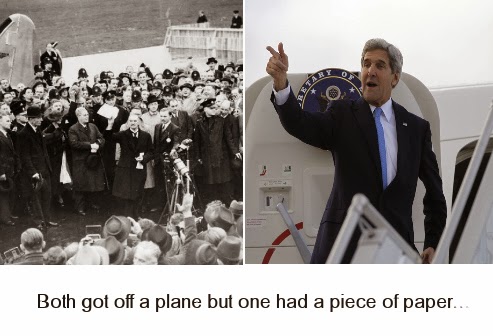
Steeped in military history and strategy, he changed his interest to psychology and listened closely to the loomings of war… the ranting of Germany’s Furher broadcast over the BBC. He had a good sense of where the world was headed in the very near future when he heard Neville Chamberlain’s infamous speech, with Hitler behind him, after the Munich Conference:

“My good friends, this is the second time there has come back from Germany to Downing Street ‘peace with honor’. I believe it is peace in our time. We thank you from the bottom of our hearts. Now I recommend you go home, and sleep quietly in your beds.”

After he heard that speech, he wasn’t about to go quietly to sleep anywhere but where the action was. 

from Adriane;
a work in progress...
11/26/2013

Saturday, November 2, 2013

A Doomsday Busride

I rode home on a bus full of commerce.
The ride was a good one
I noted that all the Questions
were sitting in the back
of the bus and that It
was an apartheid of ideas riding

in the back of the bus.
I realized, after missing my stop,
I missed my stop, and that this bus
wasn’t going to stop
… anywhere.
I shouted out to the Questions
at the back of the bus.
I desperately tried to warn them;
“Hey, Questions, the Questions belong…
you belong…
in the front of the bus and
that as long as the bus was
segregated as such it wasn’t
going to stop.”

I yelled till my throat was sore
and more Questions soared to the back of the bus
like bats flitting from a cave of angst
from behind my eyes and between my ears.
towards the back of the bus,
“Don’t you know a bus stops
that is what buses do…
buses stop at bus stops…
bus stops are lined up in such a way
that Questions get off
the bus first and Answers
follow.
It doesn’t work the other way
around… if Answers
get off at the stops first then
the bus goes nowhere
and that it isn’t a bus after all.
This bus is a roller-coaster
ride that you can’t get-off
of until the ride comes
to the end
of the line
and that you can’t get-off
it before it takes-off
on another rondo in the rodeo
of circular thinking… round and round of
Answers… Answers… answers
to Questions never asked.”

Oh no, how did I get on this bus
that isn’t a bus at all?


It is a dooms-day machine.