Thursday, November 28, 2013

War & Peace


How do you view competition in business, politics, and our personal lives?

… We have to consider our idea of happiness. Even if you are successful in making more money as you do, but you still suffer. Maybe your competition doesn’t make as much money as you do, but they are happier. So you choose to be happy or have or have the other kind of success?
Thich Nhat Hanh;
You Have the Buddha in You,
Interview with Andrea Miller:
Shambala Sun Magazine: Jan 2014
&

I have Buddhist sentiments but my heart doesn’t resonate with every interpretation of the Buddha’s teachings. I’m thinking that my mind will change with the practice of mindfulness, but there are things going on in the world that are not conducive to reason. Thich Nhat Hanh was one of the monks in Vietnam who protested that war using peaceful means: I agree with that. However, I’m not convinced that peaceful protest works universally in the here and now. The Mullahs that would condemn a woman to being stoned are difficult to convince peacefully.
There are those who are born warriors. War is a delicate tool to use against the kind of ignorance that would fly an airliner filled with innocent passengers into a tall building occupied with equally innocent workers. That kind of political fanaticism needs to be dealt with forcefully, with the immediacy of the here and now, and that is what warriors were born to do.
War is a horrible thing, it should not be left to amateurs or shouldn’t always be the first response. There are innocents involved and force is best used surgically; taking out those who wouldn’t be responsive to reason. But military force alone solves nothing without being accompanied with compassion and diplomacy for the sake of those defeated. Victory parades should resemble funeral marches. Reconstruction ought to follow the destruction of war with as much commitment in effort and money to that as the nation’s commitment to war.
Peaceful protest raises our consciousness and therefore serves a purpose for the future’s sake. Buddhist monks burned themselves in public during the Vietnam War to no apparent and immediate effect. The lives of those monks seemed wasted as the War ground on. And the results of victory by the Viet Cong were as disastrous as the American intervention to civilians and soldiers alike. Because the War had no real strategy to win, there was confusion and doubt on the home front. Lives were wasted irresponsibly to no end in sight because Americans never took war as seriously as the Viet Cong did. Peaceful protest played a role but would not have had any real impact had the war been conducted as war and not as a political opportunity for charletins.
We live in a hazardous world where we can, with a flick of a switch annihilate all traces of civilization. Total war is inconceivable to most but, to the Mullahs who strive against the West, it is a means to an end and that end is The End. I am perplexed because no apparent solution reveals itself to me. These are times the require balance and focus relying on the guidance of a Power greater than myself before I jump on any bandwagon.

geo 5,543

Tuesday, November 26, 2013

Peace in Our Time

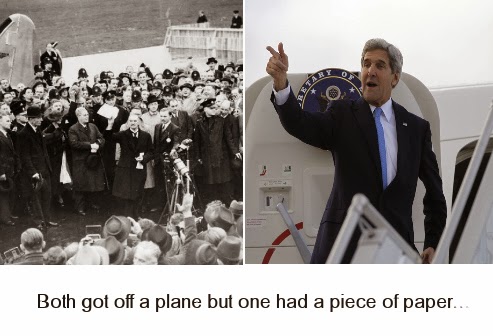
Steeped in military history and strategy, he changed his interest to psychology and listened closely to the loomings of war… the ranting of Germany’s Furher broadcast over the BBC. He had a good sense of where the world was headed in the very near future when he heard Neville Chamberlain’s infamous speech, with Hitler behind him, after the Munich Conference:

“My good friends, this is the second time there has come back from Germany to Downing Street ‘peace with honor’. I believe it is peace in our time. We thank you from the bottom of our hearts. Now I recommend you go home, and sleep quietly in your beds.”

After he heard that speech, he wasn’t about to go quietly to sleep anywhere but where the action was. 

from Adriane;
a work in progress...
11/26/2013

Saturday, November 2, 2013

A Doomsday Busride

I rode home on a bus full of commerce.
The ride was a good one
I noted that all the Questions
were sitting in the back
of the bus and that It
was an apartheid of ideas riding

in the back of the bus.
I realized, after missing my stop,
I missed my stop, and that this bus
wasn’t going to stop
… anywhere.
I shouted out to the Questions
at the back of the bus.
I desperately tried to warn them;
“Hey, Questions, the Questions belong…
you belong…
in the front of the bus and
that as long as the bus was
segregated as such it wasn’t
going to stop.”

I yelled till my throat was sore
and more Questions soared to the back of the bus
like bats flitting from a cave of angst
from behind my eyes and between my ears.
towards the back of the bus,
“Don’t you know a bus stops
that is what buses do…
buses stop at bus stops…
bus stops are lined up in such a way
that Questions get off
the bus first and Answers
follow.
It doesn’t work the other way
around… if Answers
get off at the stops first then
the bus goes nowhere
and that it isn’t a bus after all.
This bus is a roller-coaster
ride that you can’t get-off
of until the ride comes
to the end
of the line
and that you can’t get-off
it before it takes-off
on another rondo in the rodeo
of circular thinking… round and round of
Answers… Answers… answers
to Questions never asked.”

Oh no, how did I get on this bus
that isn’t a bus at all?


It is a dooms-day machine.

Friday, March 15, 2013

New Beginnings...Old Behaviors

Beyond the Walls of the Citadel
   Promises aside, Nicky had very little contact with his dad after Harry set him up in Charleston South Carolina with his new step-mom, Marilynn. Marylyn and Harry, though still married, were separated and Harry was out of the picture for the most part. Harry was out of the picture because he’d only married Marilyn for Nick’s sake. He had, in spite of his absence, kept his promise to Iniga by trying to assure that Nick would not go wanting. After all, he told himself when the vision of Iniga’s scowl would appear to him late at night; Marilyn’s house was a whole lot better than the way Nick had been left on the orphanage’s porch.

   Nick had taken to studies under a tutor he’d been assigned and even managed to complete prep-school at Bishop England Catholic High School in South Carolina before Harry used his connections to get him into The Citadel. Noting Nicky’s physique and size, Harry hoped Nick would adapt and choose a military career to be primed for life there… better than as a civilian in Ivy League colleges.

   Nick loved the discipline at The Citadel more so than he did the studies and, because he was possibly the most physically intimidating “knob” on campus, he was not hazed as much as other Fourth Class Cadets there. Engineering, mathematics, military history and instruction weren’t for him but, hell, Nick had already been institutionalized and anything, even the rigors of a Catholic prep school and the military academy, were a good deal better than the dumbed-down kindergarten of Los Prietos. He decided, after his first year at the Citadel, he had no desire for a military career nor did he have any academic aspirations. He discovered that a gift for gab and money opened doors for him that even the best colleges couldn’t. By this time, he had taken to the newly discovered privileges of wealth and the prestige that wearing the right clothes, driving the right car and living in the best neighborhoods, could avail him. He felt that he was wasting time sitting in classrooms when there was so much money to be made in the world beyond the walls of the Citadel.

   While Nick was at the Academy, and because Harry was hardly ever around much, Marilynn acquired a Realtors’ license and set up an office in Mount Pleasant. Nick fell right in with her after leaving college and the two; Nick’s natural good looks, glib tongue in conjunction with an innate ability to read other people; together with Marilyn’s pretentious airs and business acumen, made them a good team, tailor made for the polite airs of Southern congeniality. She was a matronly southern-belle whose pretenses were less annoying to Nick than they might have been had he not already spent some time at Bishop England and The Citadel acquiring manners.

  Nick took his libido into town to the gay bars and picked up on an occasional prostitute too. He hadn’t the pedigree for the society girls and he was a twenty-seven year old bachelor with what would be a good prospect anywhere else but Charleston. While sitting at Dandey’s, complaining about his last affair that ended just when he thought he’d arrived, a real-estate acquaintance asked him, “Why honey, are you wasting your time with these stuck-up bitches in Charleston? You don’t have the pedigree for these Southern Belles…”

   “Yeh, that’s true, but if only…”

   “If only… if only, darlin’… if wishes were fishes.” Nicky listened out of boredom but paid attention because this swish with the fishes was on to something when he quoted the Beatles song, “You should get back to where you once belonged… Jo-Joe.”

   “You mean California?” Nick's paranoia had him wondering what this fag knew about his stay at Los Prietos.

   “Oh sweetheart, you are getting warm…” he nuzzled up to Nick’s ear, “C’mon, Nicky, you know Santa Barbara is teeming with trust-fund babies who could care less about class distinction.”

   “What do you know about Santa Barbara?” Nicky wiped the moisture from his ear with his sleeve.

   The friend leaned back on his bar stool slurring, “Oh, they have one of the mo-ossst delightful gay-bars in the whole world, lover boy,” he then stood with his chest puffed out proudly, “go to ‘The Pub’ and be sure to tell Frankie, Donny of Charleston says, ‘Hi there’.”

   Nick’s mind was blank about the night before… he remembered the conversation with Donny about Santa Barbara. His mind raced… putting pieces of memory in place… there was cocaine; making out in the back seat of a cab; a creepy blank space after that. He was there in a strange bed. He turned over on his side to reach over… chiefly, to find out whose bed he was in. His arm fell on cold flesh… Donny was there… face down with wrists tied to bed posts… a silk tie stretched tight around his neck… shit, dead… what? Dead! Oh, God, get out of here!

   He drove to the office, hung-over, replaying the events of the night before in his mind. He remembered making out in Donny’s bed and then the screen went blank… nothing… Oh, shit, what’s going to happen… no one saw me leave his apartment… or did they? Oh, no, everyone at the bar saw us leave together… what the fuck… make up a story now… come up with something. There is sure to be an investigation. Did I leave any evidence?semen... new stuff… DNA… (DNA was in its infancy back then). Should I call Harry?

Thursday, March 14, 2013

The Crisp, Clean, Autumn Air

 I wrote this part of Adriane but didn't know exactly where to put it. It is an important background bit that gives us a sense of exactly who it is we are dealing with. I'm hoping to squeeze it into the novel in such a manner as not to muck it all up.

  A glossary of terms and index will be added by the time I get to the end of the story.


#####

The Maquisards of the Pyrenees
 

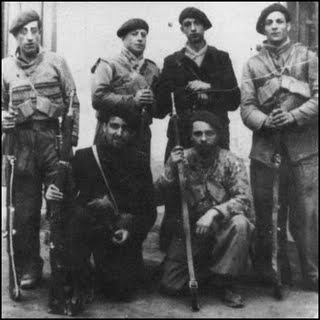
   The year was 1943 and fall had brought with it the changing of colors along the Catalonian mountain pass through to Col Du Pourtalet, in the Pyrenees. The Basque Maquis’ heart would have reveled in the crisp cool air of this landscape but he was thinking about how the summer of 1940 had brought bad news in Biarritz when the Maginot line collapsed under the relentless forces of Hitler’s blitz. Then it was just the last summer when the worst betrayal… a reminder of the betrayals by Stalinists in Madrid… the betrayal of Jean Moulin; given up to the Gestapo by another communist, Raymond Aubrac, in Lyon. Word had spread among the anarchist maquisards that no one was to be trusted in the Resistance… no one… especially the communists.

    Alesander Gotson had crossed the Pyrenees many times from 1936 to 1939. He and Marcel Fournier, Adrian’s father, had been in Guernica during the infamous fire bombing, retreating to Bilboa… surviving the War of the North and eventually held out at last in Madrid. Nightmares of squadrons in waves… Junkers, Dorniers, Heinkles, Fiat and Messerschmitt fighters … he could still see the bombs dropping and the strafing. Joining a handful of students led by Francisco Oscuro and his “Dark Ones” they stood up to the Condor Legion as long as they could and then slipped out, or melded with the population, in the confusion and rubble when the city fell with the Republican dream and his hopes for a liberated Basque Country was crushed.

   Having set up a chocolate shop in Biarritz after being released from Camp Gurs, thanks to the influence of Marcel Fournier and fellow maquis, Alesander retired from the revolution. Marcel had escaped, but not untouched, and went on to prosper from the black market in Paris. Both were disillusioned with the betrayals by the Stalinists for the constant infighting and power struggles between one faction or another in Madrid. Being a witness to the atrocities; the murder of over a thousand Nationalist prisoners ordered by the Stalinist advisor, Koltzov, Alesander, the professional guidari (warrior) was more loyal to his people, the Basques of northern Spain and southwest France, than any allegiance to political ideology. Political ideals all sounded good in the propaganda of the time but the sight of such brazen disregard for human life was what he’d been struggling against in the dust and ruins of Guernica, Bilbao and Madrid. The crimes of the Republic under Soviet usurpation equaled those of General Mola on the other side… No pasaron, indeed.


   He seen Paris fall into the dark clouds of insanity for a worse form of fascism, but he also saw the fall of France as an opportunity to help gather forces from Southern France, inflamed by NAZI oppression, sufficient to wrest Basque country from Franco. While, at the same time he did this, he could put a thorn into the side of the Vichey on the French side of the Pyrenees. The Nazis would make it easier to organize a guerrilla movement now that France itself had been occupied and Alesander was more talented at organizing guerrillas than he was at managing his chocolate shop. He’d left the shop to a cousin and disappeared from Biarritz in the Occupied Zone, before the Gestapo found his name on their lists (where it was sure to be), to take up the fight he’d abandoned in March of 1939.

   At nightfall he waited with a half-dozen of his maquisards lined up and ready to light flares illuminating the improvised landing strip. The feint purr of the Lysander in the distant black sky assured him the plane was on time… within seconds... and there would be no waiting around. Alesander didn’t appreciate the help his little band was getting from the British. He didn’t believe in the adage, “The enemy of my enemy is my friend.” After dealing with the Stalinist, Anarchist and Republican infighting in Madrid, Alesander observed that the worst enemy of the Resistance was the resistance itself. Why would the British government be free of similar play-pen shenanigans? This was life or death to him while they, at times, seemed to view the guidariki as pawns in the big game. His heart beat freer high up in the Pyrenees where his decisions didn’t have to go through a central committee.


   “There it is …” a young guidari called out. The commander’s attention was on the landing strip…  a black Lysander landed squarely in the midst of two rows of flares, having been lit only moments before, coming to a stop fifty feet from those marking the end of the strip. Alesander admired the ability of these pilots to land on a dime and take off again without a minute lost. He watched as a tall, broad shouldered man with close cropped, blond hair and a huge backpack, jumped to the ground.


   The plane was immediately turned around by his men and headed back down the strip to disappear into the night, “This way,” he said in English and the group darted off into the forest.

   After about a half-hour hike they came to a small hut where a young girl, Iniga, one of maquisards waiting for their return, lit a kerosene lamp and put it in the middle of the table. Alesander thought of her as a fiery angel with a moon face and cupid-bow lips framed by unruly and wild brown tufts tied down under a provocative Basque Beret. She was only seventeen but had already been slated for a train from Gur to Drancy and sure death before he, and the former préfet of Aveyon, Jean Moulin, managed to wrangle her release two years before. Though barely a teen at the time she had witnessed the assassination of Durruti at the Bridge in Madrid and had become a hardened veteran by1943.


   “So, what are we doing… no supplies… no ammo… nothing from you Brits but another face to feed?” She blurted out before the tall muscular, blond man could say anything. He was busy opening a suitcase he’d carried from the plane on the table revealing a compact radio.


   "The rest will be dropped tomorrow night… we have another radio code-book…" returning her glare and adding casually, "the others have been compromised. That is why I’m here.”

   Alesander had heard that accent in Madrid. It was the accent of the Lincoln Brigade he’d fought with in the last days of the Republic in Madrid. He had a kinship with the Americans… more than with the British whose class distinctions made them almost as nasty as the Germans. But, some of the Americans of the Lincoln Brigade were idealists who’d become as disillusioned as he.


   The American pulled another kit out of his pack and put it on the table. Beside two dry cell batteries, there were two thirty-two caliber Welrod pistols with silencers and several boxes of ammo.


    No one used their real names and very few asked, but Alesander finally recognized the man. He was Harry Baker, aka, Perro de Caza... the Bird Dog, and had come to Madrid in the last weeks before everyone with any sense scrambled out of there. He never got to know him but he suspected that Mr. Baker played both sides to his benefit. Madrid was far away but the wounds… the distrust… it never heals.


   After everyone bedded down outside the hut, Baker sat at the table and lit a pipe, “You are familiar… you were in Madrid at the bridge?”


   “Yes, and you were with the International Brigade at Manzanares…” Inga added, “When Durruti was taken out…” She then went back out of the hut.


   After she left, Alesander picked up on what the girl was implying, “It was almost over then. How did you get out?”


   “That’s classified, sorry,” was Baker pulling rank?


   Alesander swiftly yanked his Welrod from inside his jacket, holding it steady between Baker’s eyes. “This round in the chamber is classified too… so tell me Mr. Baker, how did you get out of Madrid?”


   Baker didn’t flinch… there was no reaction. It seemed as though he didn’t care one way or another whether Alesander pulled the trigger. “Let me just say, it was a matter of knowing where the bricks, walls and body parts fell during the bombardments.”


   “They say… some I know to be reliable… they, and there was more than one, I’ve heard them say that it was a Stalinist that shot Durruti.” Alesander had been with Durruti, the leader of the anarchist column, during the drive to Zaragosa.


   “It could have been,” the American still hadn’t blinked.
   

   Iniga burst in the door and came to a halt when she saw the two men poised in an absurd diorama… neither moved. “I hate to interrupt… better put a bullet in his head, Alesander, we have to get moving.” 

   Two more maquisards entered the hut, “Bind him…,” Alesander ordered, “we’ll pick up our conversation later.”


   Baker put his hands behind his back without resistance while Iniga, with a cord of sinew, had begun to bind them. Alesander stopped her from binding him that way, saying, “Tie them to the front, he can move easier that way. We don’t need to have him stumbling in the dark.”


   “Thanks,” Baker nodded in agreement.


   Two hand guns, 9 mm Lugar semi-automatic pistol and MP 40 German machine pistol with a detached shoulder stock,
a makeshift garrote along with two knives in shoulder sheathes, were lifted from inside his heavy jacket. Iniga ran her delicate fingers across the smooth side of the peculiar blade of the biggest one.
 
   Baker grinned at the girl as she examined the odd shaped heavy dagger, “It’s a Smatchet. You can jam that fucker right through an SS helmet. You can have it… I’ll keep the others.”

   She approved as the others left the hut.Alesander still hadn’t put the Welrod down until Baker’s hands were secured. She then snuffed the lamp and the band filed out up the hill, splitting up into two or three man groups. 


   Iniga took the point while Alesander held back behind Baker. He stepped aside and took a stand on an outcrop to pause and check his watch. The column in pursuit would be almost to the hut by this time. He could see a few lights from farm houses in the valley below from his viewpoint but the darkness hid nearly everything else. Had he not known the terrain so well, he wouldn’t have been able to guess where the hut they’d just left might have been… he could hear one of their pursuers loudly complaining that they had to dismount their horses at the hut and hike.

   Alesander left his perch… slinging his British Sten and taking up the rear behind his compliant and strangely complacent captive, he puzzled over what to do now. He could have blown the hut with plastique at this time but he didn’t want to give the Regulares any reason to retaliate with reprisals on the villagers below who had as little knowledge of the actions of the maquis as they did the Guardia Civil. The Regulars weren’t as brutal with reprisals as the Civil Guard, or the Germans in France, but trouble of any kind in the countryside could turn the locals against them and the Maquis sorely needed the support of the villagers.

   They made their way along a path known only to a few; skirting the limestone cliffs that dropped several hundred feet from the barren landscape to wind, below the tree-line, sidelong the steep slopes down and over a crest, forested with firs and some beech trees to a hidden limestone cave where they met the others and stashed the radio. All except the three then dispersed, some down into the town, Jaca: others scattered elsewhere. 


   It is said that the garrison of Jaca’s mutiny against the monarchy and its suppression in 1930 gave birth to the beginnings of the Spanish Civil War. At the cave the three; Iniga, Baker and Alesander, would bind their fates far beyond the immediate circumstances of that day in 1943.

   “Unbind him,” Alesander nodded to Iniga.


   “What, you want to give him a chance to escape?” she sneered indignantly.


   “He could have had that chance a half dozen times by now…” Alesander answered. An uncustomary grin showed the worried features, so weary of warfare, on what ought to have been a youthful face, “You should be a little less eager for blood, my dear one.” But he knew full well how bitterly the savagery of oppression etched itself into the lives of what ought to have been the carefree youth of those times. The Civil Guard had taken her parents to a wall and gang-raped her at fourteen.
She went straight to the front lines in Madrid as a messenger before it fell in '39. Alesander understood because he himself had his first taste of combat as a messenger in '36 when he was fourteen. He was only twenty years of age now but had already been a hardened veteran since the Civil War started a lifetime ago in '36.

   Alesander returned Baker’s weapons, “Sorry, we can’t be too careful with our trust." Gesturing for her to unstrap the sheath, "Iniga, give him back his smatchet.”


   “But he said I could have it…” she pouted intriguingly girlish.


   “We have to set up a drop site…” Baker interrupted.


   “Please can I keep the smatchet?”  Iniga flashed her mock, little girl, pout at Baker and patted her side where under her coat the smatchet was holstered.


   “Sure,” Baker smiled flashing his straight white teeth. He couldn’t figure if she was patting her breast teasingly or the smatchet sheath. He then turned his head up the hill and held his hand out, palm down, to signal silence… he heard voices.


The three fanned out and took cover. Alesander’s took a position above and to the side between a couple of boulders where he could watch the entrance of the cave. That radio in there was crucial for their survival. Ambush strategies and tactics had been worked out long before by the maquisards but Baker had only his well honed instincts to land in a perfect place to observe the approaching column. Iniga found cover a hundred meters up the hill camouflaged behind some scrub beneath some beech trees.
 

   This was an operation with too many problems for Alesander. He preferred quiet operations, where a couple of spikes on a mountain railway track could be dislodged, resulting in a supply train headed for Southern France to derail and tumble into a gulch long after his men would be enjoying a few carafes of wine in Jaca; but this one was suspiciously compromised from the start. Those being his feelings regardless, he would get a chance to gain respect for Baker’s abilities this morning as an ominous mist cast an aura of mystery around the arrival of two Civil Guards and a half-dozen Regulars.

   As the squad approached, Baker let the point pass within feet of his position. Alesander had been in so many ambushes by now that he felt calm and focused. The men looked tired and finally the squad leader ordered a rest. They had to scramble up and down these trails, far from the warmth and security of their post. Dumping their packs, rolling and lighting up cigarettes, each made a tremendous amount of noise. From his position he could see Baker gesture, pointing out the sergeant… claiming him for his own… as he was separate from his squad…. taking a dump. Garrote ready, Baker waited, making sure that the sergeant finished his dump before taking him out. He didn’t want to mess himself up in close quarters like that. He gave Alesander a hand signal to wait.

   Iniga had the smatchet out and poised to use on one of them leaning against the same beech she had been using for cover. He’d taken off his German style helmet adorned with the Franco Eagle emblem, to roll up and light a cigarette.  This bothered her because she wanted to see how that damned blade worked even though he’d set aside his new, and hardly ever used, parade-ground Muaser rifle within easy reach. Still, in spite of her youthful petulance she was disciplined enough to wait for Alesander’s signal. He was in the line of sight for both her and Baker but, of course, she had no idea what the waiting was about.
 

   One of the men spoke loud enough for all to hear, “They are probably in Jaca by now… having breakfast… eh?” there would be no answer from the sergeant.


   Alesander was in position to catch most of the rest with his Sten when Baker made his move. These men were green... Franco had to send his more experienced, so-called volunteer, Blue Divisions to the Russian Front to appease Hitler. The army never recovered from the loss of experienced fighters. Now Spain, with the exception of a few Moroccan veterans, had nothing but barracks mavens to send out on patrol: they looked good for the parade grounds but were of little use in the field.


   It was over before anyone was able to lift a weapon. Everyone had all moved in such precision that only a short burst from Alesander’s Sten made any sound. Baker worried that the sound of that burst might have carried. He had taken out three with a knife as Iniga made short work of two more with one of the Welrods. The three had moved in unison as though choreographed in a deadly dance.

   In the end, Iniga had one pinned against a tree by the Mauser she held casually to her side with the business end of the barrel only inches from the boy’s crotch. He was no older than Iniga.


   “What are we going to do with him?” she almost pled.


   Alesander walked straight up to the quivering kid with tears of fear on his adolescent face, saying calmly, “Its going to be alright…” he assured the boy as he put a silenced round into the side of the youth’s head. The boy dropped to the ground in front of Iniga’s Mauser muzzle.


   She turned to catch Alesander walking away as though he’d only delivered a paper. She understood… no prisoners… but a deep ache welled up in her with tears of her own.She then put the boy's helmet back on his head and slammed the smatchet through it to the hilt.
 

   Jerking away she called out to Baker, “Hey, it went through his helmet like a butter knife!” displaying the bloody smatchet.
 

   Baker kicked the body over, the helmet rolled off to show the wound in the back of the kid's head. The helmet had a hole in the middle of the top, “You did that afterwards.”

   “I had to try it,” she answered coyly and smiled broadly.


   He gave her a pat on the back and the three of them got busy hiding the bodies.

   War… the crisp, clean, autumn, mountain air, now smelled of blood, shit and
urine soaked trousers,from exploded intestines. All three were young and should have been cramming for studies in dorms or playing soccer… but here they were. It had to be accepted… it is unfair… every dead soldier has a grieving family… a mother… a father… a lover… war!


Monday, March 11, 2013

Steely Gray Eyes & Blood Red Gladiolas

Now, at sixteen, Nick was approaching manhood after bouncing from the orphanage to foster homes… to another foster home… to another foster home… to Los Prietos Boys camp.  Harry Baker would have his hands full de-institutionalizing his son but he also had his hands full with his own medical condition. He knew he had four, maybe five years or more, if only he could quit smoking before the emphysema that was gradually drowning him would take him under. He owed it to Iniga… he’d promised her that much… and these were the few kinds of promises men like Harry were honor bound to keep.  

  She was there in the V.A Hospital in Boise after he’d managed to verify, through Marcel Fournier, that she was a veteran of the resistance in France: a concentration camp survivor, Franco’s prisons and, while in the resistance, a rescuer of American pilots during D-Day in Normandy. He’d done so after Alesander reached him through old contacts in the OSS and informed him she had been suffering cancer, under an alias, at a sheep ranch near Boise Idaho. He’d only quit his business a few years before and dropped all his aliases for his real name.

   Coming “out from the cold” then, Harry had married Marilyn to have for once a normal life. The posting of wedding notices in the local paper didn’t escape the attention of Alesander’s associates whose antennae had been out looking for Harry since he’d heard of Iniga’s cancer. Harry then went to work with connections that landed her in the V.A. hospital of Fort Street in Boise.

    He came onto her ward with a bouquet of flowers and a gnawing anxiety. Her skeletal frame was hardly discernible from the tubes, oxygen mask and wires to monitors. He put the flowers, Blood Red Gladiolas, in a vase and sat by her as she slept.


   She awoke with a start, “Hurry?” she slurred…. sedated, trying to say Harry through a thickened tongue, 

   
   “Yes, it’s me.”

   “And, along comes the injustice of God.” She managed a weak smile.
 

  “What, Iniga?”

   “That fate would shove your fuckin’ face in front of my eyes before I die.”


   “Gratitude was never your strong suit…”


   “I am grateful that I can tell you about our son.” Her contempt softened as she said, our son.


   To Harry's uncustomary affectionate mind, the lines of premature age and the darkened skin under her eyes wrought by cancer and had not withered away the beauty of her cupid bow lips or the steely determination of her eyes were steely gray like his: gray eyes that were no longer framed by wild shocks of black Basque hair. They were set deep in the death’s skull of her shaved head: eyes that were pleading. Harry was moved by the sight of Iniga submitting to pain… to see her in physical weakness was... well, he remembered his last vision of her in the bath at their departure in Spain.


   “He is in California…” she paused to take another hit off the oxygen mask; “A boy’s camp of some sort. He still has your name, Papa.”


   “What do you want me to do about him?” Harry could tell, as soon as he protested, that any objections he might have would be vanity, He saw no need to tell her of his own emphysema. but he tried… “He doesn’t know me.”


   “He needs help. I had no idea of his situation…” she arose on one arm and spoke forcefully, “until we tracked down that damned wet-nurse.”


   Harry saw again her fierce determination as she continued, “The cur left him with nuns like a donation … a bag of groceries!” she wheezed…”I was too weak to follow-up…. but I found out where he is now.”


If he was honest with himself about it, Harry hadn’t given Nick much thought at all over the previous sixteen years. Love wasn’t part of his vocabulary. It was an expense… a far too costly an investment in time and energy to be committed to it. He had to do what he knew he needed to do now. He needed to do it now because he realized… or allowed the realization… that within the deep recess of buried emotions… he loved Iniga and, in loving Iniga,his betrayal of her years ago required something of him.

   “It is up to you Harry, find him.”
 

   “I will.
 

   “Try to give him a life, Harry.”
 

   “I will.”
 

   “Oh, yes, Harry…”
 

   “Yes…”
 

   “Thanks for the gladiolas. Red glads were the favorites of the nuns at la Ventas.” She turned her head to the side to hide her tears, “Now go away please.”
 

   Harry knew then what the rest of his life would be. He took the first flight from there the next morning and never again see Iniga's steely gray eyes before she died.

Saturday, March 9, 2013

A Sewer of Deceit

   Harry set little Nicky up in another safe-house when he was hatched, until his mama had escaped la Ventas. Three months later she had been taken to the safe house by the bribed Padre. Their first contact was a fiery one. Harry’d gotten the news that his efforts were successful via a phone call from the same bribed Padre. She was taking a bath when the wet nurse let Harry in the apartment.

   “You can wait here, senor.” She gestured towards a straight backed chair next to Nicky’s cradle.


   Harry didn’t even think of lifting the screen over the cradle to look in at his son like any proud father would.


   Harry had counted on his betrayal being a secret and that she wouldn’t know of it. It wouldn't be so bad, he thought, that his affair with Iniga would pick up where it had left off before she was arrested. He sat and waited as the wet nurse knocked on the bathroom door, “Senora, your husband is here.”


   “I don’t want to see him!”


   The ruse that Iniga and Harry were lovers, or even friends, dissipated as he crossed the room and opened the bathroom door. He stood in awe, stunned, at the raw beauty of Iniga’s naked body. She looked better, even after the deprivation of prison, than the last time he’d seen her and he longed to hold her in his arms. “La Ventas treated you well?”


   She was still startled at the sudden opening and reached for a gun that was no longer there, as one would have always been before her arrest. “What makes you imagine that you are welcome here?” she spat out the words with contempt.


   “Is this the gratitude I get for bustin' you loose?” Harry knew this was a weak thing to ask but he had no words for the unaccustomed guilt her indignant posture extracted from his gut.


   “You are alive now because I have no way to kill you, Harry,” she showed her palms as the hatred seethed from the cupid lips he longed to press to his. Those cold steel-grey eyes diverted his eyes to her firm breasts, and then to a newly stitched scar that went down the length of her belly: a Caesarian birth, no doubt.


   The conviction of her words left Harry with little to say. Words weren’t his strong suit and neither was the expression of emotion. He understood that she knew what had happened but he tried just one time to explain, “Alesander is in Biarritz.”


   “That was your trade?” she looked up at him.


   “Yes,” and his chest ached to lift her… to draw her body to his.


    “Go, and take Nicholas with you,” she spoke with a determined voice but her steel grey eyes welled with tears, “I’m going back.”


   “No, I won’t take him, he needs a mother.” Harry made a desperate plea to what he imagined to be her maternal instincts.


   “Okay, I’ll keep him for now, but you’ll never see him again.” She countered.


   “You’ll die in the Pyrenees, Iniga, the U.S. has a base in Rota now,” he had to make this one last argument, though he knew it would not mover her. “The CIA is very good at taking care of insurgents. Even if you win… look at Iran…” referring to Mohammad Mosaddegh’s parliamentary government before the CIA re-installed the Shah in 1953, “you think they will tolerate a Basque government run by anarchists, or, most likely, Communists?”


   “No, Harry, my time in La Ventas convinced me. My world is not yours,” she then added, “I can’t go back like you and your kind. I can’t drop out and drop in as I please, like you; Alesander and I are guidari. We counted ourselves as dead the minute we picked up a weapon to resist.”


   "Alesander, I have good reason to believe, is retiring in Biarritz. His stay in Carabanchel convinced him," Harry lay down his trump card hoping she'd...

   "He will never retire until he is dead," she fired back with a hand she knew she ought best fold.

   “So, you are convinced you want martyrdom. You want to die in a worthless Jihad and you choose this over motherhood?”


   He could see that he'd hit her in the chest with a hammer and that the blow only caused her face to set in a concrete resolve that no hammer could bust up.

   Harry remembered the first time he and Iniga met in a cabin in the Pyrenees during the war. She was only a teen then with Alesander’s guerrilla group;
a smatchet on her belt,her frame so small that any rifle would outweigh her, but she carried a full pack and a fierce determination he'd just seen again. He let his eyes caress her body one more time before closing the door. 

   He heard her from shout from behind the bathroom door as he left the apartment and his son, Nicky, “Adios, Bird Dog, we are not the same as you say, you are a whore!”

   “Adios, my fiery angel.” He wasn’t used to poetic adieus and he hoped that leaving Nicky with her would temper her revolutionary fervor. She could have left Spain and Franco’s oppression for Southern France like Alesander in Biarritz, but it would not be so. They would not see each other for over four decades… as she lay dying.
 

   Nicky was lost to him too. She arranged for her wet nurse to care for him. When the wet nurse immigrated to the US with Nicky she put the bastardo, her ticket for immigration, on the steps of a Catholic orphanage with his birth certificate in a manila envelope pinned to his blanket a few days after her feet hit the ground off a Greyhound Bus in Los Angeles. A life begun in the sewer of betrayal, abandonment and deceit, left Nicky with a perspective on life that might be understood under these circumstances.